
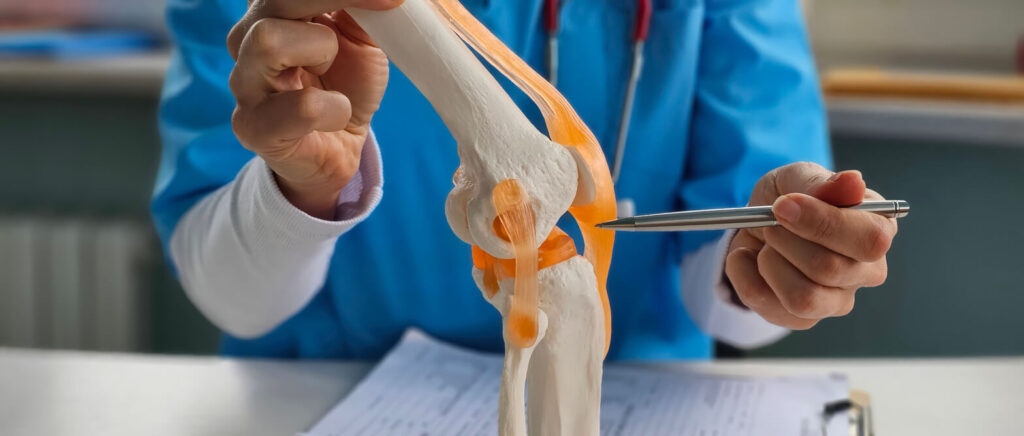
A meniscus tear causes pain, swelling, and mechanical issues in the knee, and treatment ranges from rest to surgical repair.
- Pain and sudden swelling. The knee often swells immediately after an injury, and it continues to cause significant discomfort.
- Mechanical knee joint problems. You might feel your knee catch, lock, or give way during routine movements.
- Customized medical treatment approaches. Medical professionals offer conservative care and surgical options to restore joint function.
Recognizing meniscus tear symptoms early is the first step toward reclaiming your active lifestyle and finding relief from persistent knee pain. A meniscus tear is one of the most common knee injuries, and it affects athletes and nonathletes alike. The meniscus is a C-shaped piece of tough, rubbery cartilage that acts as a shock absorber between the shinbone and the thighbone.
What Is the Anatomy of the Knee Joint?
Before exploring meniscus tear symptoms, it is helpful to understand the complex anatomy of the human knee joint. The knee is a hinge joint formed by the femur, the tibia, and the patella, which work together to facilitate movement. These bones rely on a sophisticated network of ligaments, tendons, and cartilage to remain stable and functional during physical activity.
The meniscus serves as a vital piece of cartilage positioned squarely between the femur and the tibia. Each knee contains two menisci: the medial meniscus on the inside of the knee and the lateral meniscus on the outside. These tough, rubbery structures act as shock absorbers, distributing weight evenly across the joint and preventing the bones from rubbing together.
Without a healthy meniscus, the excessive friction between the bones would quickly lead to the development of osteoarthritis. This degenerative condition breaks down the articular cartilage, causing chronic pain and severe joint stiffness over time. Therefore, recognizing and treating cartilage damage early is critical for preserving your long-term joint health.
Who Is at Risk for Sustaining a Knee Cartilage Injury?
Athletes who participate in high-impact sports face a significantly higher risk of sustaining a traumatic meniscus injury. Sports like football, basketball, soccer, and tennis require sudden stops, sharp pivots, and rapid changes in direction. These explosive movements place immense rotational stress on the knee, which can easily tear the delicate cartilage.
However, sports injuries are not the only cause of this common orthopedic problem. As people age, the cartilage in their joints naturally begins to wear down, lose its elasticity, and become more brittle. This age-related degeneration means that older adults can experience this injury after simply twisting awkwardly while standing up or stepping on an uneven surface.
Additionally, individuals who perform heavy physical labor are more susceptible to degenerative and traumatic knee injuries. Jobs that require repetitive squatting, kneeling, or lifting heavy objects place constant stress on the knee joint. Over time, this cumulative wear and tear weakens the meniscus, making it highly vulnerable to tearing.
What Are the Early Signs of Cartilage Damage?
When you injure this vital cartilage, you will likely notice immediate changes in how your knee functions. The most common early signs include sharp pain, stiffness, and noticeable swelling around the joint. You may also feel a popping sensation at the exact moment the injury occurs. This is a clear warning sign of structural damage.
If you ignore these persistent warning signs, the torn cartilage can continuously irritate the surrounding joint lining. This chronic irritation leads to ongoing inflammation, persistent pain, and an increased risk of developing early-onset arthritis. Seeking a prompt medical evaluation ensures you receive the correct diagnosis and a customized treatment plan.
What Are the Detailed Meniscus Tear Symptoms?
When a tear occurs, the resulting meniscus tear symptoms can vary widely depending on the size and location of the damage. A minor tear might cause slight pain and mild swelling that develops gradually over two to three days. In these mild cases, you might still be able to walk and perform your daily activities with only minimal discomfort.
Conversely, a severe tear will produce immediate, intense pain and rapid swelling that severely restricts your mobility. You might feel a distinct pop in the knee, followed by a sensation that the joint is entirely unstable. Patients with severe injuries often report that their knee gives way unexpectedly, causing them to stumble or fall.
One of the most concerning meniscus tear symptoms is a mechanical block known as joint locking. This occurs when a fragment of the torn cartilage breaks loose and becomes wedged between the femur and the tibia. When the knee locks, you will find it physically impossible to straighten your leg completely until a medical professional intervenes.
How Do Medical Professionals Diagnose Knee Injuries?
When you visit an orthopedic clinic with meniscus tear symptoms, the medical staff will begin with a comprehensive clinical evaluation. Your provider will ask detailed questions about how the injury happened and what movements aggravate the condition. They will also review your medical history to rule out other potential causes of knee pain.
During the physical examination, the doctor will carefully palpate the knee to identify areas of tenderness along the joint line. They will perform specific orthopedic tests, such as the McMurray test or the Thessaly test, to assess the integrity of the meniscus. These tests involve bending, twisting, and applying pressure to the knee to see if the movements trigger a painful click or pop.
If the physical exam suggests a problem, the provider will likely order an X-ray to rule out bone fractures. Because cartilage does not show up on an X-ray, the provider will likely order a magnetic resonance imaging scan to visualize the soft tissues. In some cases, a provider might use an ultrasound or a CT scan to gather more detailed images of the knee joint.
What Are the Comprehensive Nonsurgical Treatments?
For patients with minor injuries or degenerative tears, conservative management is often the most appropriate and effective initial approach. The primary goal of nonsurgical treatment is to reduce inflammation, manage pain, and restore basic joint function. Patients are typically advised to rest the knee and avoid activities that involve twisting, pivoting, or heavy lifting.
Ice therapy is a highly effective, natural way to manage the immediate swelling associated with acute knee injuries. You should apply an ice pack to the affected area for 15 to 20 minutes several times throughout the day. Wrapping the knee with an elastic compression bandage can also prevent fluid buildup and provide comfortable, gentle support.
Over-the-counter nonsteroidal anti-inflammatory drugs, such as ibuprofen (Advil) or naproxen (Aleve), can significantly reduce pain and swelling. Your doctor might recommend these medications to help you manage the discomfort during the early stages of the healing process. Always take these medications exactly as directed and consult your healthcare provider if you experience any adverse side effects.
When Is Surgery Necessary for This Injury?
If conservative treatments fail to relieve your joint pain, your orthopedic provider may recommend a surgical procedure. Surgery is often necessary if the tear is large, if it causes the knee to lock, or if the patient is a highly active athlete. The location of the tear also plays a critical role in determining whether it can heal on its own or requires surgery.
The outer edge of the meniscus has a rich blood supply, which means small tears in this zone can sometimes heal naturally. However, the inner two-thirds of the meniscus lack a direct blood supply, making it incredibly difficult for tears in this area to heal without intervention. In these complex cases, doctors frequently turn to arthroscopic surgery for torn meniscus repair to restore the joint.
What Are the Advanced Surgical Interventions and Procedures?
When conservative treatments fail or when a tear is particularly severe, surgical intervention becomes the safest path forward. Surgeons carefully evaluate the specific characteristics of the tear, including its pattern, size, and location within the cartilage. Tears located in the outer portion of the meniscus have an excellent chance of healing if they are surgically repaired.
Conversely, tears in the inner portion lack the necessary blood supply to heal properly, even with surgical stitches. In these cases, the surgeon will typically perform a partial meniscectomy to trim away the frayed, damaged cartilage. This procedure leaves as much healthy cartilage intact as possible to preserve the joint’s natural shock-absorbing capabilities.
Today, nearly all of these procedures are performed using arthroscopic surgery for torn meniscus treatment. This modern surgical technique requires only two or three tiny incisions around the knee, rather than a large, open cut. Using miniature surgical instruments inserted through the small incisions, the surgeon carefully repairs or removes the damaged tissue to restore knee function.
What Can You Expect During the Recovery Process?
Immediately following your surgery, you will spend a short time in a recovery room while the anesthesia wears off. Because arthroscopic procedures are minimally invasive, the vast majority of patients are discharged to go home on the exact same day. For the first few days, you must focus on resting the knee, elevating the leg, and managing your post-operative pain.
Physical therapy usually begins within a week after the surgery, and it is arguably the most critical component of your rehabilitation. The initial therapy exercises will focus on restoring your range of motion and preventing scar tissue from forming inside the joint. As your knee heals, the therapist will gradually introduce resistance exercises to rebuild your muscle strength and endurance.
A study published in the PMC established formal consensus guidelines that highlight the importance of structured rehabilitation following meniscus repair. According to this consensus, comprehensive post-surgical physical therapy is important for regaining strength, improving flexibility, and ensuring a safe return to sports. The research confirms that the rate of returning to play following an isolated meniscus repair can range between 71 percent and 100 percent.
You must follow your physical therapy plan closely and communicate any returning meniscus tear symptoms to your healthcare provider immediately. For a partial meniscectomy, patients can often return to their normal daily activities within a month of the procedure. However, a complete meniscus repair requires a much longer and more cautious rehabilitation protocol to protect the delicate surgical stitches.
How Can You Maintain Healthy Knees?
Taking proactive steps to protect your knees can significantly reduce your risk of suffering a painful cartilage injury. One of the most effective strategies is to maintain a healthy body weight through a balanced diet and regular exercise. Every extra pound of body weight places an additional four pounds of stress on your knee joints during walking and running.
Some useful prevention strategies include:
- Wear proper athletic footwear. Choose athletic shoes that provide adequate support and cushioning for your specific activities.
- Warm up the body thoroughly. Always perform dynamic stretches before you engage in intense physical exercise.
- Increase physical intensity slowly. Gradually increase the duration and intensity of your workouts to avoid sudden strain.
You should also incorporate a variety of low-impact exercises into your weekly fitness routine to build strength without overloading the joints. Swimming, cycling, and using an elliptical machine provide excellent cardiovascular workouts while placing minimal stress on your knees.
If you do engage in high-impact sports, make sure you use the proper form and technique to avoid unnecessary joint strain.
Find Relief from Meniscus Tear Symptoms in Dover, NJ
If you are struggling with persistent knee pain, do not wait for the condition to worsen before seeking professional medical help. The experienced team at Orthopedic Associates of West Jersey provides comprehensive, state-of-the-art orthopedic care for all types of sports and joint injuries. We stress conservative treatment options when appropriate, ensuring you receive the least invasive care necessary to heal.
When surgery is required, our skilled surgeons deliver advanced options such as arthroscopic surgery of the knee to relieve your pain. Our ultimate goal is to deliver the most effective treatment regimen that will allow you to safely return to your favorite activities.
Contact Orthopedic Associates of West Jersey today at (973) 989-0888 or use our appointment request form to schedule your consultation and take the first critical step toward reclaiming your freedom of movement.
